Current Startup and Venture Investment News as of September 12, 2026: Mega-Rounds in Infrastructure, AI Chips, and Defense Technologies, IPO Preparations for DeepSeek and Oura, Strategic Deals by Meta and Salesforce, and Key Signals for Investors and Funds.
The second week of September 2026 revealed the true direction of venture capital. In just one day, the ten largest deals generated approximately $4.8 billion, with 93% of this amount going to only three companies — The Boring Company, Positron AI, and Mach Industries. The market did not become "broadly risky": investors are willing to write substantial checks only to those startups that control scarce resources — tunnels, inference chips, optical connections for data centers, or defense production.
Key events shaping the venture market agenda for Saturday, September 12, 2026:
- The Boring Company closed its Series D round at $3 billion with a valuation of $23 billion, with the UAE as the lead investor, and the deal accompanied by a contract to construct over 150 km of tunnels.
- Positron AI raised $875 million at a valuation of $5 billion just seven months after its round at $1.06 billion.
- Mach Industries expanded its Series C by another $600 million; the defense startup's valuation doubled to $3.7 billion in three months.
- Harvey secured $550 million at a valuation of $15.5 billion, reinforcing the idea of vertical AI as a stand-alone category.
- DeepSeek hired CITIC Securities to prepare for an IPO on the Shanghai STAR Market at a potential valuation of around $75 billion.
- Meta and Salesforce are acquiring AI teams: Stilla.ai is already within Meta's perimeter, while Listen Labs is in discussions for approximately $2 billion.
The Boring Company: $3 Billion and Sovereign Capital as a Market Entry Strategy
The largest deal of the week is the $3 billion Series D round for The Boring Company at a valuation of $23 billion. The lead investor was the United Arab Emirates, with co-investors including Sequoia Capital, Andreessen Horowitz, and Baron Capital. Importantly, the financing came together with an agreement for the construction of over 150 km of tunnels in the UAE.
For venture investors, this represents a new model: sovereign capital acts simultaneously as a shareholder and anchor customer, alleviating the company's risk of customer acquisition. However, engineering and design risks remain — the company's main operational showcase continues to be the Vegas Loop, while projects in Los Angeles, Washington, and Chicago have been suspended. Nevertheless, the $23 billion valuation establishes a new norm: infrastructure startups with technology, political access, and the capability to participate in tenders on the scale of tens of kilometers receive venture multipliers.
AI Infrastructure: Inference and Photonics Instead of Another Chatbot
The center of gravity for venture investments in artificial intelligence has decisively shifted from models to the "hardware" that supports them.
Positron AI: $875 Million as an Alternative to Nvidia in Inference
The startup from Reno (Nevada) closed a Series C round of $375 million and a Series C-1 of up to $500 million, achieving a valuation of $5 billion. The round was led by NEA, Atreides Management, Valor Equity Partners, Andra Capital, SemiAnalysis Capital, and Jim Clark; the deal also involved Qatar Investment Authority, Cisco Investments, and Naver Ventures. The Asimov processor employs a "memory-first" architecture with up to 2.3 TB per chip, and mass production is scheduled for the second half of 2027. Over 50 previous-generation racks have already been deployed within Oracle Cloud Infrastructure.
Ayar Labs: Optical Connections at $5 Billion
The silicon photonics developer raised an additional $150 million for its March Series E, bringing the total round to $650 million, and increasing its valuation to approximately $5 billion, compared to $3.8 billion at the beginning of the year. Strategic investors include Nvidia, AMD, and MediaTek. The demand from public companies supports the thesis: Oracle reported quarterly capital expenditures of $28.5 billion, while hyperscalers issued approximately $220 billion in bonds over the year to finance data centers.
Defense Technologies: Mach Industries Doubles Valuation in a Quarter
Mach Industries raised another $600 million as part of the Series C expansion, bringing the total round volume to approximately $900 million. The company's valuation increased from $1.8 billion in June to $3.7 billion. Investors included Ribbit Capital, Infinite Capital, Bedrock Capital, and Sequoia. The company produces vertical take-off drones, long-range strike systems, and counter-drone systems, while also expanding into propulsion systems through the acquisition of Exquadrum.
Investors are financing not a standalone platform, but rather an industrial base: vertical integration of production is becoming a key barrier to entry. The defense sector in 2026 has definitively ceased to be a niche category in venture capital — over the past six months, Anduril raised $5 billion, and Finland's ICEYE secured $1.2 billion.
Applied AI: The Premium for Owning the Workflow
Parallel to mega-rounds in infrastructure, funding continues for vertical AI companies, whose protection is built not on the model, but on integration into regulated processes:
- Harvey — $550 million at a valuation of $15.5 billion (led by Diffusion and Lightspeed); the legal AI startup has released its own model Tenet based on open weights.
- Inspiren — $70 million Series C at a valuation of $550 million led by NewView Capital; AI monitoring in nursing homes.
- Rogo Technologies — approximately $30 million in strategic investments from Citi, Barclays, BNP Paribas, MUFG, and Société Générale; banks become both shareholders and clients.
- Graph AI — $13.3 million from Insight Partners and Bessemer for pharmacovigilance automation.
The common denominator for these deals is a specific buyer, measurable operational results, and a high cost of replacing the product in the client's stack.
M&A and Strategic Deals: Corporations Acquire Teams, Regulators Observe
Meta has acquired the Stockholm-based startup Stilla.ai, which emerged from stealth mode after a $5 million seed round, to enhance business agents in WhatsApp and Messenger. Salesforce is negotiating the purchase of Listen Labs for approximately $2 billion — notably, the startup had recently signed a term sheet for $125 million at a valuation of $1.5 billion. This illustrates how AI companies are becoming targets for acquisition well before reaching a traditional scale.
Concurrently, the U.S. Department of Justice is examining Nvidia's licensing deal with Groq for $17–20 billion for potential antitrust violations. For investors in chip startups, this is an important signal: the "license plus team transition" model as an alternative to notified mergers may become unviable.
Asia: DeepSeek Prepares for IPO, Alibaba Valuates UniPat AI at $2.5 Billion
DeepSeek has brought in CITIC Securities and three additional underwriters to prepare for its offering on Shanghai's STAR Market; the process is expected to initiate by the end of the year. Concurrently, the company is conducting a pre-IPO round at an estimated valuation of around 500 billion yuan (approximately $75 billion) following its June round of $7.4 billion. Alibaba leads a $300 million round in UniPat AI — a platform for evaluating and training models — at a valuation of $2.5 billion, with Tencent and HSG participating. China is placing billion-dollar prices on AI "tools," not just the models themselves. In India, Swish secured $24 million in a Series B from Bertelsmann India Investments for ten-minute food delivery.
IPO Market: The Window is Open, but Selectively
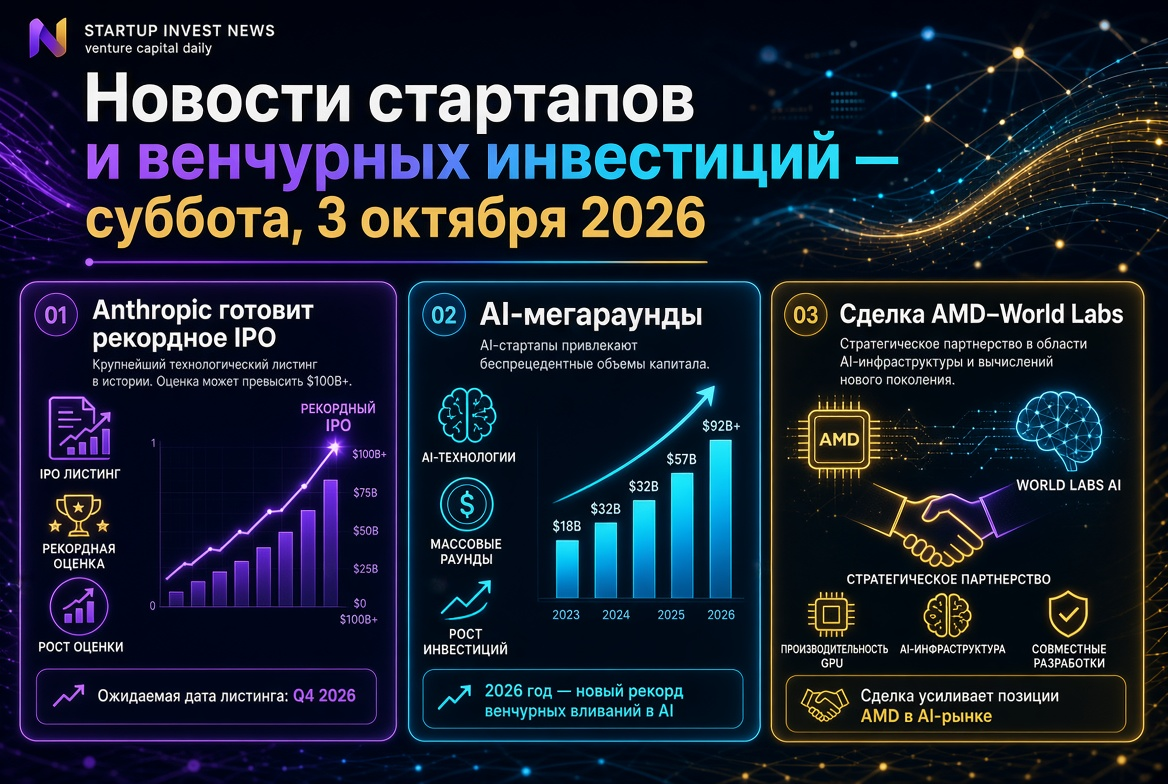
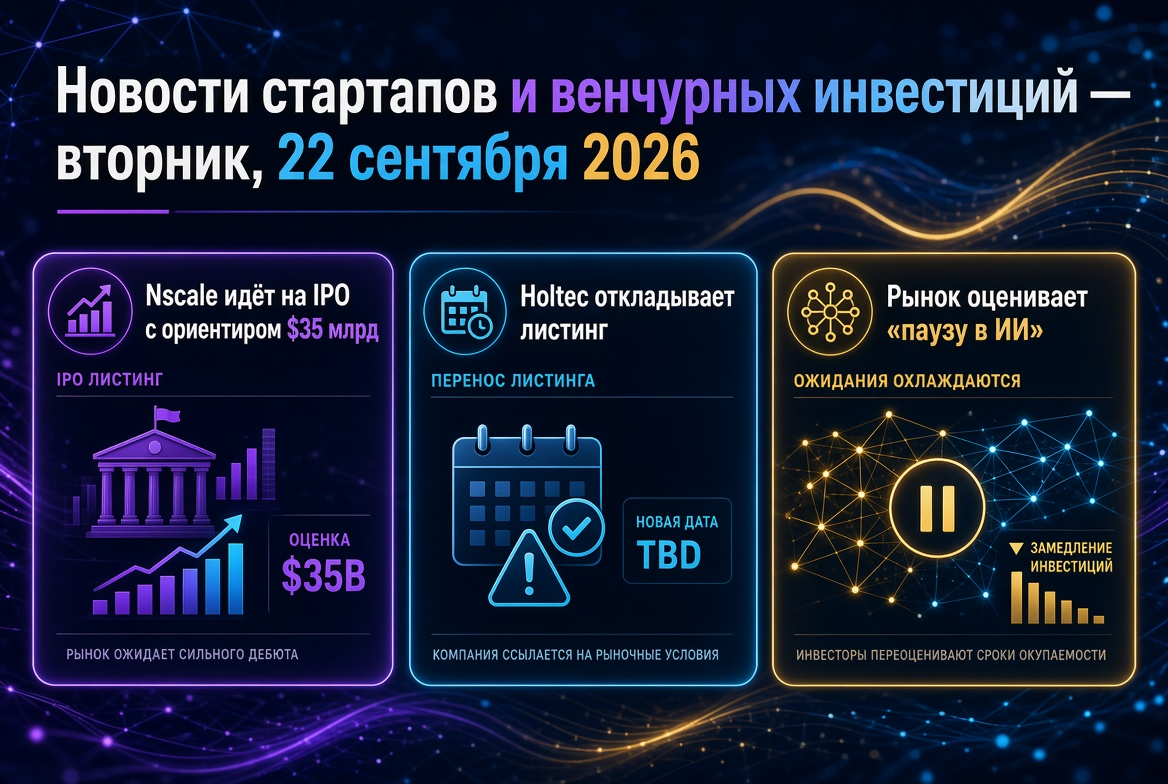
Oura has filed for a listing on Nasdaq under the ticker OURA, aiming to raise up to $3 billion at a valuation exceeding $16 billion; the offering is expected by the end of September. Meanwhile, Motive Technologies has withdrawn its IPO of approximately $600 million — the public market continues to differentiate issuers into "AI giants" and everyone else. Anthropic, as of mid-week, has postponed its offering to October. Direct listings are experiencing a record year in quantity, but not in returns for investors.
Russia and the CIS: The Funnel Has Narrowed
As of September 9, approximately 90% of Russian startups have proven unprepared for investment: from 2,681 applications for one of the industry showcases, only 2–4 projects made it to the final selection, while investors made offers exceeding 700 million rubles. The selection process is tightening — the market is progressively filtering out projects without confirmed economics. The global context is reinforcing this trend: according to KPMG, the global volume of venture capital investments for the first half of 2026 reached $560.4 billion, but the top 10 deals claimed nearly half of this amount, with OpenAI and Anthropic accounting for about $217 billion.
What This Means for Venture Investors and Funds
The September landscape fits into the formula "capital is abundant, scarcity remains." Practical takeaways for managers:
- Strategic capital becomes a distribution channel. The UAE for Boring, banks for Rogo, Oracle for Positron — an investor that is concurrently a customer reduces commercial risk more effectively than a higher valuation from a financial fund.
- Capital intensity is no longer a liability if it buys a barrier. Factories, chips, and photonics are financed in tranches tied to specific milestones: design, production of marketable products, client qualification.
- "AI-powered" is not an investment thesis. The premium goes to those who own the regulated process, data, and switching costs.
- A barbells market requires two strategies. Mega checks are concentrated in the U.S., while seed and early rounds in Europe, India, and China remain small and rigorously selected.
The venture market enters the fall of 2026 with record capital reserves and a narrowing circle of recipients. Companies that cannot be replicated by the next model release are the winners.